Our Testing
NicoLeaks publishes independent laboratory results for nicotine pouch products in a consistent, searchable format. The goal of testing is to provide objective product composition data that helps readers understand what was measured, how results are reported, and how different products compare.
Testing is performed by the independent third-party laboratory Eurofins, at their Lidköping, Sweden location that specializes in oral tobacco and nicotine product analyses.
Why We Test Products
We want to empower our consumers with accurate information. We believe that providing testing results improves transparency and product understanding.
Testing does not determine whether a nicotine pouch is safe or risk free, but it does provide objective data about what a nicotine pouch contains.
The results are used as part of an internal review process to identify whether a product aligns with declared specifications and relevant market standards.
While we conduct testing on a broad range of products, only products for which the manufacturer has agreed to public disclosure of the results can be published on NicoLeaks.
After a product has been tested, the laboratory reports are published with a symbol and colour marking for the nicotine level (20 mg per pouch is our limit).
What Does NicoLeaks Test?
A NicoLeaks report may include measurements related to nicotine content, pH, water content, pouch weight, humectants, tobacco-specific nitrosamines, selected trace metals, microbial activity, mycotoxins, and polycyclic aromatic hydrocarbons. These results are reported so nicotine pouch products can be reviewed using the same types of measurable data.
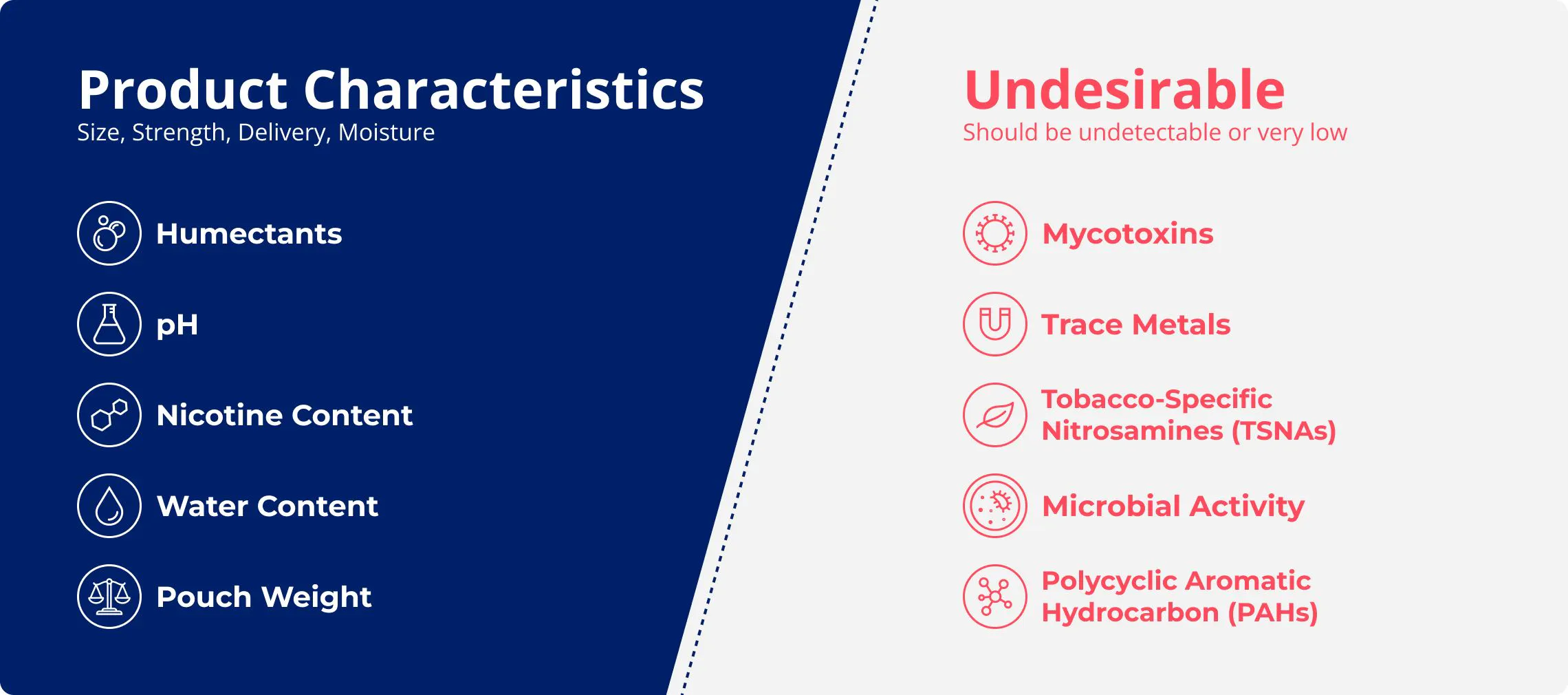
How to Read NicoLeaks Laboratory Results
NicoLeaks results should be read as product composition data. Testing can help verify measurable product characteristics, support transparency, and make nicotine pouch data easier to compare. It does not evaluate health effects, establish product safety, or show that a product is risk-free. A laboratory report should be viewed as a snapshot of the tested sample, not as a guarantee that every batch of the same product will be identical.
Every laboratory measurement has a margin of error. In NicoLeaks reports, this is called measurement uncertainty. In simple terms, this means the actual value could be slightly higher or lower than the reported result, within a certain percentage range shown in the report.
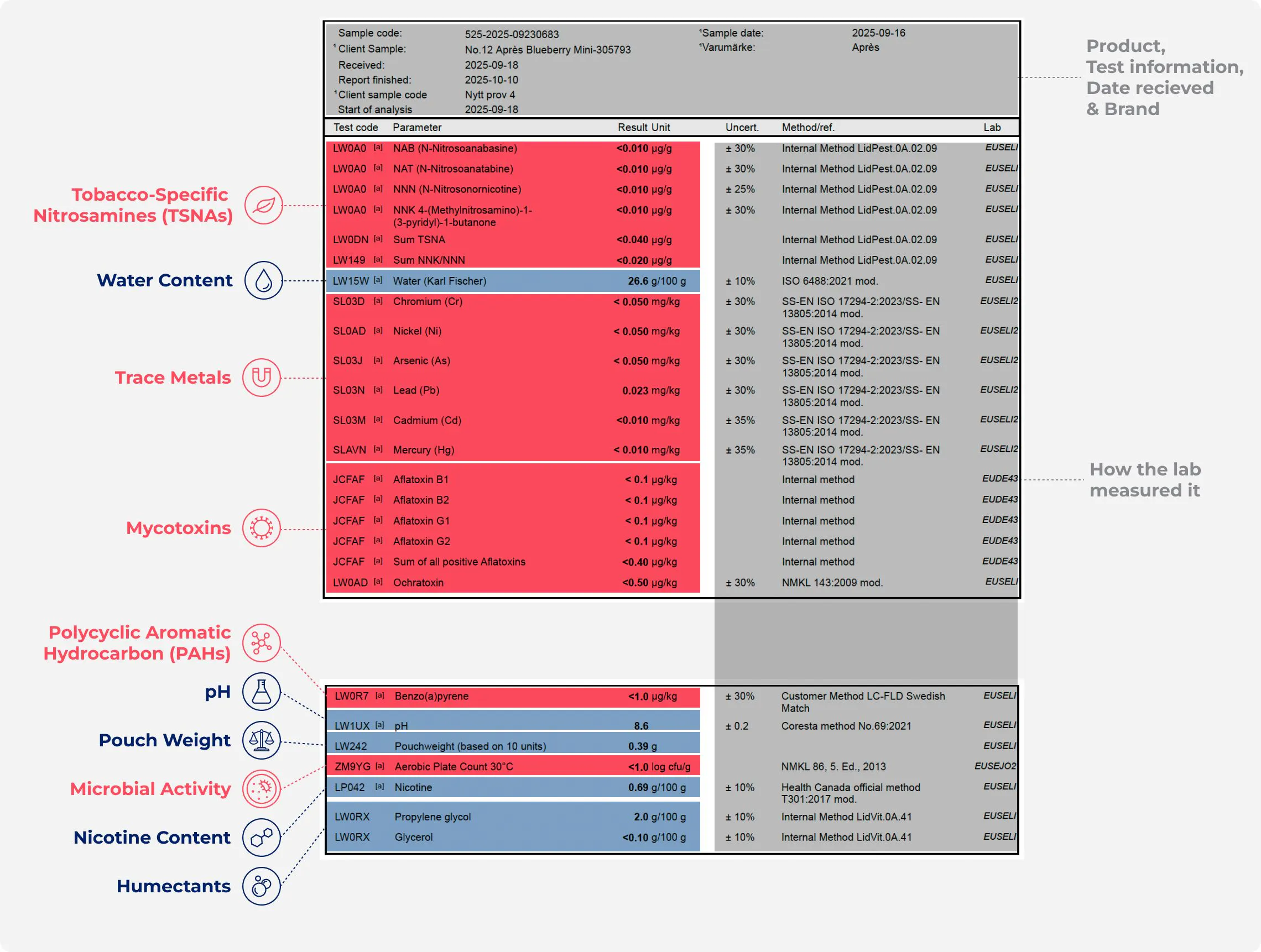
Nicotine Content: Milligrams per Pouch
Nicotine content is one of the core measurements in a NicoLeaks report. Some products list nicotine as milligrams per pouch, while others list nicotine as milligrams per gram. NicoLeaks reports nicotine values as milligrams of nicotine per pouch so products can be compared using the same unit.
NicoLeaks only considers listing nicotine pouch products that contain 20 mg of nicotine per pouch or less. In some cases, higher-strength products are tested to better understand what they actually contain. Products above this threshold are marked as “Does not meet Haypp standards.”

If a product is marked with a green shield with a checkmark, the value listed is within the recommended limit for nicotine per pouch.

If a product is marked with a red triangle with an X, the value listed exceeds 20 mg of nicotine per pouch and is not listed.
pH in Nicotine Pouches
pH is a measure of how acidic or alkaline a water-based solution is. The pH scale ranges from 0 to 14, with 7 considered neutral. Lower values are more acidic, and higher values are more alkaline. In nicotine pouch testing, pH is measured because it is one part of overall product chemistry and can help readers compare formulations.
pH can influence the form in which nicotine is present in a pouch. At higher pH values, a greater proportion of nicotine may be present as free nicotine, which can affect how nicotine is released and absorbed through the oral mucosa. However, pH is only one part of the formulation. Salt or resin backbone, moisture, pouch weight, total nicotine amount, ingredients, and use behaviour can also contribute to how a product performs.
Moisture in Nicotine Pouches
Moisture describes the amount of wet ingredients measured in a nicotine pouch. In NicoLeaks reports, the moisture value is calculated by adding together the weights of water, propylene glycol, and glycerol in the tested product. The result is the percentage of moisture by weight (e.g., if a pouch weighs 0.5 g and has 35% moisture, wet ingredients make up 0.175 g). Moisture can contribute to pouch texture, mouthfeel, and ingredient release.
Pouch Weight and Formulation Factors
Pouch weight helps put nicotine content into context because two products with the same nicotine concentration per gram may contain different amounts of nicotine per pouch if the pouch weights differ. Other formulation factors (e.g., moisture, pouch material, fillers, flavourings, sweeteners, and pH-adjusting ingredients) can also influence product characteristics.
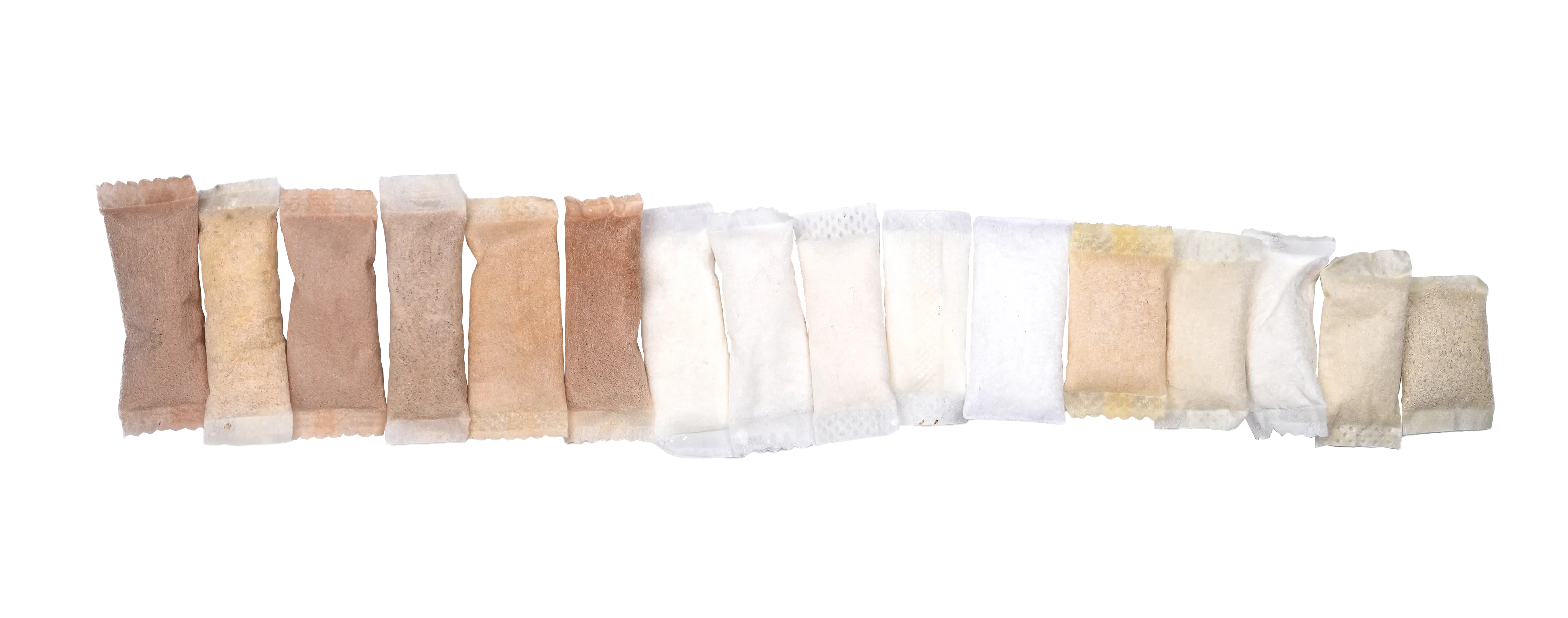
Selected Substances Measured
NicoLeaks reports may include selected substances that are relevant when reviewing nicotine pouch composition. These can include tobacco-specific nitrosamines, selected trace metals, microbial activity, mycotoxins, polycyclic aromatic hydrocarbons, and humectants. Reporting these measurements in one place helps readers evaluate product composition beyond nicotine content alone.
Tobacco-Specific Nitrosamines
Tobacco-specific nitrosamines, often shortened to TSNAs, are a group of compounds that can form from nicotine and related tobacco alkaloids during tobacco curing, processing, or storage. Because most modern nicotine pouches do not contain tobacco leaf, TSNAs are not present at the high levels seen in many tobacco-based products. However, they can still be relevant to check because nicotine used in a pouch may be derived from tobacco, and very low trace levels have been reported in some nicotine pouch testing.
NicoLeaks measures TSNAs because they are one of the established substance groups used to evaluate tobacco and nicotine product composition. Including them helps readers see whether these compounds were detected in the tested sample and, if so, at what level. This supports transparency and quality comparison, but the result should not be read as a safety rating or as proof of health risk.
Selected Trace Metals
Trace metals are metals or metal elements that may be present in very small amounts. In nicotine pouch testing, selected trace metals can include substances such as arsenic, cadmium, chromium, lead, and nickel, depending on the laboratory method used. These substances can come from natural background levels in raw materials, environmental exposure, ingredients, processing equipment, or manufacturing inputs.
NicoLeaks measures selected trace metals because they are commonly included in product quality and contaminant screening for tobacco and nicotine products. Measuring them helps show whether the tested sample contains detectable levels and allows results to be reviewed in a consistent way across products. As with other NicoLeaks results, these measurements describe the composition of the tested sample and do not determine whether a product is safe or risk-free.
Testing Does Not Determine Product Safety
NicoLeaks testing focuses on measurable product characteristics, not health effects. The results can help show what was found in a tested sample, whether nicotine content aligns with declared values, and how products compare using common measurements. The results should not be interpreted as proof that a product is safe or risk-free.
See Tested Products in the NicoLeaks Database
This page explains what NicoLeaks measures and how to interpret the results. To browse published product tests, readers can use the NicoLeaks database and review individual product pages for test-specific notes, tested sample information, availability details, and downloadable laboratory reports.
Relevant Product Standards
CORESTA Guide N° 35 Technical Guide for Nicotine Pouch Safety and Quality
SIS standard: Technical specification SIS/TS 72:2024 - Nicotine-containing, tobacco-free oral products - Safety and quality related requirements
The German Industry Federation BVTE standard (German language): Produkt- und Werbestandards für tabakfreie Nikotinbeutel
The German Industry Federation BVTE standard (English language): Produkt- und Werbestandards für tabakfreie Nikotinbeutel